
Sorex araneus
Woodshrew / Vanlig näbbmus / Eurasian Shrew
Sorex araneus
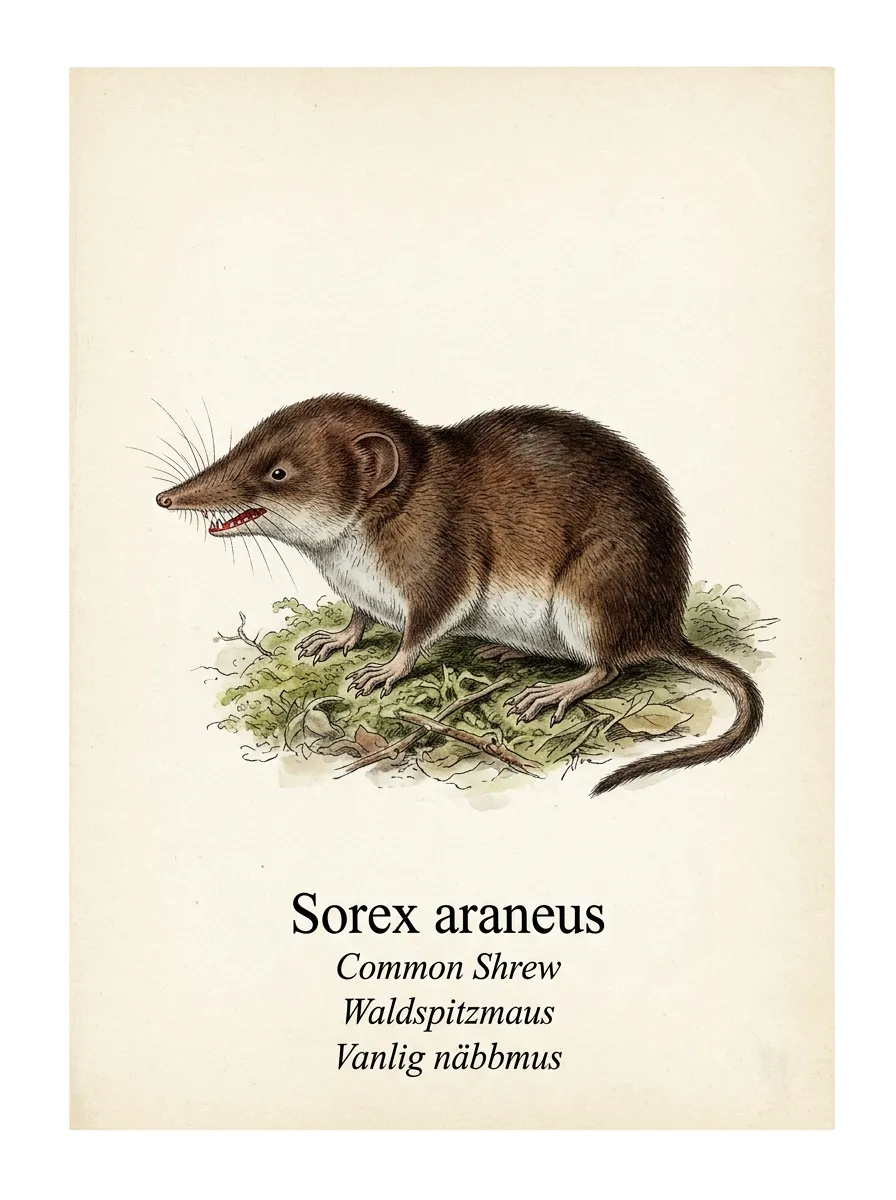
Illustration: Sorex araneus
The common shrew (Sorex araneus) is the most widespread insectivore in Fennoscandian forests and is recognizable by its distinct tri-colored coat. Despite its small size, it plays an immense role in regulating the macrofauna of the leaf litter.
Its hyperactive metabolism forces it into an almost continuous intake of insects and worms. A unique phenomenon is its ability to drastically shrink its internal organs to survive the winter in the taiga (Dehnel's phenomenon).
Facts & Characteristics
- Scientific Name: Sorex araneus
- Category / Order: Säugetiere (Mammalia)
- Nature, Taiga & Waters of Västerbotten: Nature, Taiga & Waters of Västerbotten
- Native to Northern Sweden: Native to Northern Sweden
Questions & Answers (FAQ)
What is understood by Dehnel's phenomenon in the common shrew?
Dehnel's phenomenon is a unique morphological adaptation to winter food shortages in the taiga. Before winter, the skull, brain mass, and other internal organs of the shrew shrink significantly (up to 20%), reducing their already enormous basal metabolic rate. In spring, the organs partially regrow.
Why does the common shrew need to feed almost continuously?
Due to their extremely high surface-area-to-volume ratio, they lose body heat quickly, requiring a rapid metabolism for thermoregulation. They must consume up to 150% of their own body weight in insects, worms, and arachnids daily; a few hours without food inevitably lead to starvation.