
Misty star
Great Gray Owl / Lappuggla / Great Gray Owl
Misty star
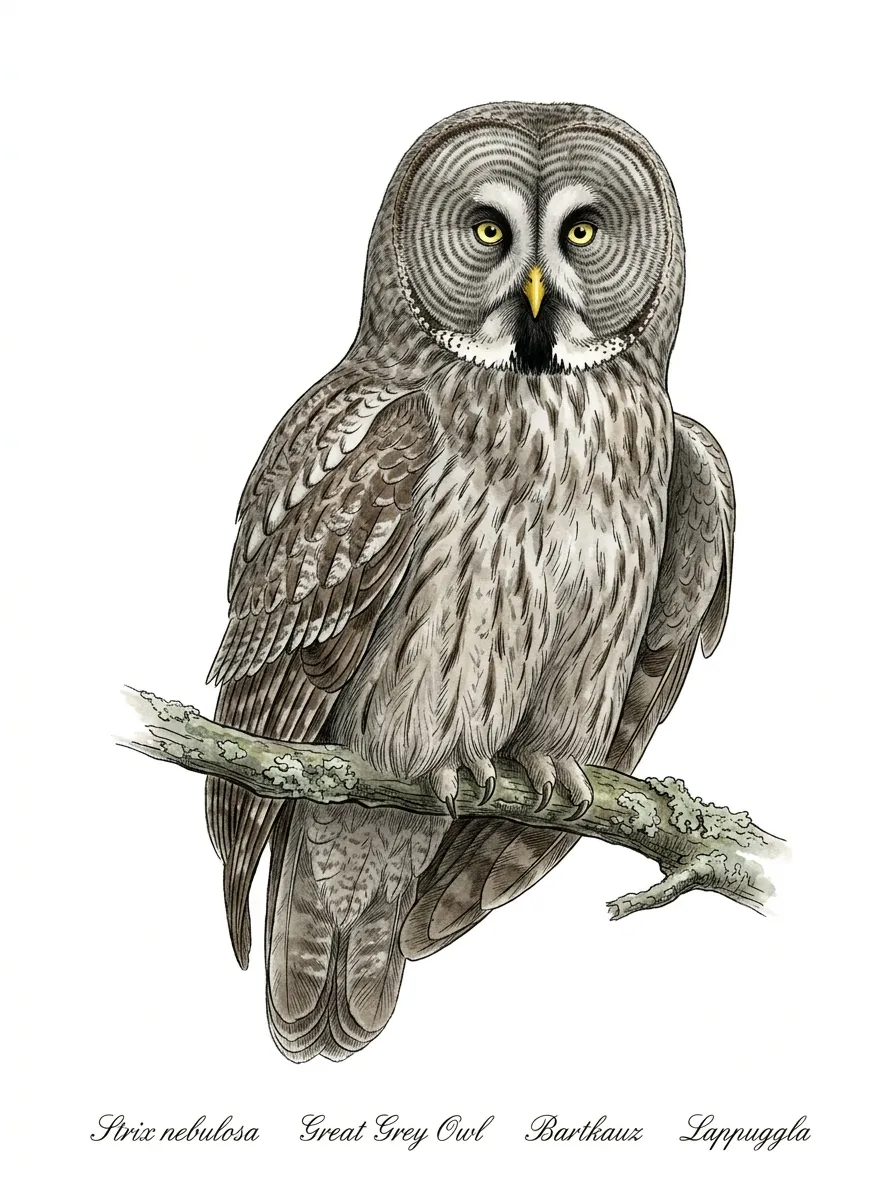
Illustration: Strix nebulosa
- Plumage: Soft, voluminous mottling of ash-grey, silver, and brown with fine vertical dark streaks; broad loose feathers giving a massive silhouette. - Beak: Yellow, sharp curved bill positioned above a distinct black chin patch ("beard") bordered by white crescent markings. - Body build: Impressively large stature with a massive round head, broad rounded wings (wingspan 135–150 cm), but surprisingly light body mass. - Distinctive details: Huge facial discs with fine dark concentric rings, relatively small yellow eyes, extraordinarily large asymmetrical ear openings.
In the old-growth boreal forests of Lapland, the great grey owl hunts silently. The coarse woody debris (CWD) of these forests supports the small mammals that form its main diet.
Facts & Characteristics
- Scientific Name: Strix nebulosa
- Category / Order: Vögel (Aves)
- Nature, Taiga & Waters of Västerbotten: Nature, Taiga & Waters of Västerbotten
- Native to Northern Sweden: Native to Northern Sweden
Questions & Answers (FAQ)
What is the great grey owl?
The great grey owl (Strix nebulosa) is one of the largest owl species, known for its massive facial disk that directs sound to its ears.
Where does this species live?
It primarily inhabits dense taiga and adjacent peatlands in northern Sweden, favoring old-growth forests with abundant deadwood.